Risk, Safety, & Resilience

Boost Your Well-being with Upcoming Health Events


Risk, Safety, & Resilience is committed to supporting the health and wellness of our employees. The Employee Health & Well-Being team have several events coming up designed to help you stay informed, stay healthy, and feel your best!

Join Us September 17 for Tuesday Treks

Date: September 17
Location: Tuesday Treks Route
The Employee Health & Well-Being team will be out on the Tuesday Treks route offering complimentary blood pressure checks and distributing valuable information on managing and understanding blood pressure. Swing by during your walk for a quick check-up and some helpful tips to keep your heart healthy!

Flu Clinics – Protect Yourself This Season

With flu season approaching, it’s important to protect yourself and those around you. Employee Health & Well-Being, in partnership with Student Health Services and Human Resources, is hosting flu clinics across several campuses, so mark your calendars and get vaccinated!

Take advantage of these convenient opportunities to safeguard your health. Sign up today, and encourage your colleagues to do the same!

Stay Informed, Stay Healthy!

Whether you’re stopping by for a quick health check during Tuesday Treks or rolling up your sleeve for a flu shot, we hope you’ll join RSR in taking proactive steps towards a healthier future.

Advancing Excellence in Emergency Management and Fire Safety: George Mason’s Ongoing Commitment 

Dedicated to providing invaluable learning opportunities, the Risk, Safety, and Resilience (RSR) Emergency Management & Fire Safety team at George Mason University regularly hosts events that bring together professionals to share best practices and gain insights from one another. These initiatives not only highlight George Mason’s contribution to these critical fields, but also underscore its role in fostering a collaborative and informed professional community. 

Fire Safety Symposium: A Tradition of Excellence 

On June 21, RSR organized the 12th Annual Fire Safety Symposium, held at the University of Virginia. Spearheaded by Gregg Black with support from Gina Reistrup and Matthew Forker, the symposium welcomed 38 fire safety professionals from higher education institutions across the Commonwealth. This event provided a unique platform for the State Fire Marshal to address all institutions of higher education (IHE) simultaneously, emphasizing its importance as a singular opportunity for unified communication and collaboration in fire safety practices. 

Since its inception in 2011, the Fire Safety Symposium has become a cornerstone event for George Mason, consistently facilitating the exchange of knowledge and fostering relationships among fire safety professionals. The annual gathering not only reinforces best practices but also highlights Mason’s ongoing leadership and dedication to fire safety in the higher education sector. Risk, Safety, and Resilience founded this annual event and has continued to plan, organize, lead, and deliver the Fire Safety Symposium at institutions across the Commonwealth.  

UCC Boot Camp: Cultivating New Leaders in Emergency Management 

The same day at Mason Square, another significant event took place — the International Association of Emergency Managers Universities and Colleges Caucus (UCC) Boot Camp. Organized by David Farris, this event catered to emergency managers new to the higher education environment, providing them with essential training and insights specific to their roles. 

With over 40 participants, the boot camp was a resounding success, marking the second time it has been at George Mason. David Farris, alongside Marc Barbiere (Georgetown University), who serve as UCC region III co-chairs, played pivotal roles in ensuring the event’s success. By focusing on the unique challenges and responsibilities of emergency management within higher education, the UCC Boot Camp stands as a testament to George Mason’s commitment to nurturing the next generation of emergency managers. 

A Legacy of Impact 

Through events like the Fire Safety Symposium and the UCC Boot Camp, RSR continues to make significant contributions to the fields of emergency management and fire safety. These initiatives not only enhance professional development but also strengthen the network of professionals dedicated to maintaining safe and resilient educational environments. George Mason’s dedication to hosting and organizing these events underscores its pivotal role in shaping the future of safety and resilience in higher education. 

Preparing for Seasonal Illnesses

As we fade out of summer and into fall, we’re providing important reminders to help keep the Mason Nation strong!

Follow the sound practices we’ve used in the past: 

  • Stay up to date, as eligible and recommended, on seasonal vaccines;
  • Get a COVID or Flu test when you have symptoms;
  • Isolate when you have a contagious illness; and
  • Mask up when it makes sense.

Except for students seeking care at Student Health Services, Mason no longer has COVID-specific policies or procedures in place and instead we are relying on our community to follow guidance provided by both their own primary care provider (PCP) and local and federal public health.

Vaccines

Information and recommendations on the newest COVID-19 vaccine approved by the FDA will be available to the public shortly after the Centers for Disease Control and Prevention (CDC) Advisory Committee on Immunization Practices meeting being held today (September 12, 2023).  COVID-19, Flu vaccines and Respiratory Syncytial Virus (RSV) vaccines (if recommended for you) are available through many pharmacies, urgent care facilities, and doctor’s offices.

Tests

Faculty/Staff

While COVID testing at Mason is no longer available to faculty and staff, tests are available through urgent care facilities, some doctor’s offices, and over-the-counter. It is prudent to determine if you have COVID when feeling symptoms in order to follow isolation and masking guidance geared towards limiting the spread, especially to high risk individuals.

Physicians and Urgent Care facilities can also test for Flu, RSV and other illnesses as symptoms indicate.

Students

Those being seen at Student Health Services may be tested for COVID or other respiratory illnesses, as medically indicated.  Visit the Student Health Services COVID Services webpage for detailed guidance specific for Mason students.

Masks

Masks are still very effective at limiting the spread of respiratory illnesses.  It is recommended to mask up when emerging from isolation, and prior to and when interacting in person with those that are at higher risk for severe illness and complications.  As we learned during the pandemic, N-95 masks provide a greater level of protection than cloth and surgical masks.

Absences

Faculty/Staff

Those that need special accommodations or arrangements related to telework or leave should engage their supervisor and Human Resources when needed. Faculty should be flexible with students who are ill and not require medical excuse notes.

Students

Those that need special arrangements related to class attendance or assignments should contact their instructor(s).

Additional Resources

Here are some links that may help you navigate seasonal illnesses and their impacts:

Stay safe and strong Patriots!  

Angela Chezem, MD, FAAFP  

Medical Director, Employee Health & Well-being

Safety, Emergency, & Enterprise Risk Management

ehw.gmu.edu 

Nandini Koka, MD, FAAFP, FCUCM 

Executive Director, Student Health Services

University Life

shs.gmu.edu 

SEERM offers opioid overdose response and Naloxone training

Mason’s Employee Health and Well-Being team, a division of Safety, Emergency, and Enterprise Risk Management (SEERM), will begin offering Opioid Overdose Response and Naloxone Training to the university community this spring. This one-hour course, available for free to faculty, staff, and students, will cover how opioid overdoses happen, risk factors, and how to respond to an opioid overdose emergency with the administration of Narcan (Naloxone). Participants will receive a certificate and a Naloxone kit upon completion of the course.

According to the Centers for Disease Control and Prevention (CDC), more than 80,590 people in the United States died from an opioid-related drug overdose in 2022. Naloxone has been approved by the Food and Drug Administration (FDA) to rapidly reverse an opioid overdose. In March 2023, Naloxone received FDA approval to be dispensed over the counter and is expected to be available to the public by summer of this year.

To register for an upcoming training, please visit ehstraining.gmu.edu. For help with registration or for other questions, please contact [email protected]. Attendance is free and first come, first served. SEERM will continue to add more sessions of this course in addition to the upcoming dates listed below.

Upcoming dates (seating limited):

April 24, 11:30 a.m. to 12:30 p.m.
May 8, 1 p.m. to 2 p.m.
June 7, 1 p.m. to 2 p.m.

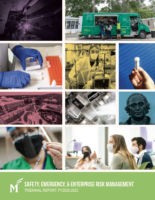
SEERM Annual Report, FY2020-FY2022

Safety, Emergency, & Enterprise Risk Management is proud to present its annual report, covering activities and accomplishments from fiscal year (FY) 2020 through FY 2022. This report details SEERM’s extensive COVID emergency response as well as routine operations over the last three fiscal years.

To download this report as a PDF, click here.

To view this report in an interactive format, click here.

Register for Active Threat / Stop the Bleed Training

This course provides information on how to respond to an active threat situation (a person with a weapon intent on causing harm), hands-on experience using a tourniquet,  and providing first aid to someone who is the victim of an attack. Participants will learn the RUN-HIDE-FIGHT response to active threat situations. This class offers participants the ability to ask what-if questions regarding active threat situations. This class is open to all faculty, staff, and students.

To register, click here or email [email protected] for support.

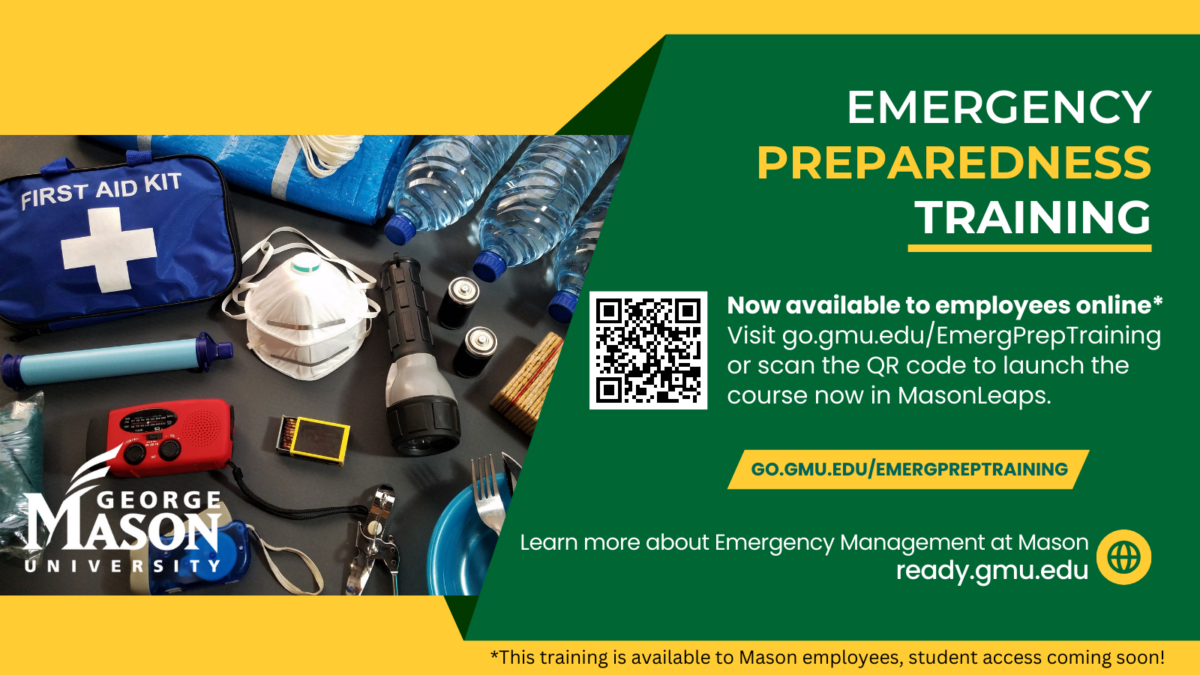
Emergency Preparedness Training Now Available Online

Emergency Preparedness Training is designed to help you:

  • develop an understanding of fundamental emergency management principles;
  • introduce emergency planning and response resources provided by Mason;
  • assess and plan for known threats and anticipate hazards that might occur in the future; and,
  • review emergency response roles and responsibilities within the Mason Community.

Employees can access training here on MasonLeaps. Student access is coming soon.

To learn more about Emergency Management at George Mason University, visit ready.gmu.edu.

Stop the Spread – Monkeypox

If not automatically redirected, please click here

Important Safety and Emergency Preparedness Information

Dear Patriots,

You have either heard of or experienced last month’s erroneous active threat announcement. Fortunately, this was not a real event, but instead an error caused by an external vendor which has been resolved.  For more information about this situation, please visit our advisories page.  Many members of our community reacted quickly using their training to find a safe location, barricade/lock doors, and helped others as necessary. Although we regret this incident, it does remind us of the importance of individual and institutional preparedness. We continue to explore ways to make our campuses as safe as possible.  Please help us in this endeavor by educating yourself on recommended preparedness and response procedures and report emergencies or suspicious conditions to University Police by calling (703) 993-2810.

Mason Alert: All students, faculty, and staff are strongly encouraged to register one or more cell phone numbers with Mason Alert, the university’s emergency notification system. Mason Alert text messages provide timely notification of events affecting your safety.

Active Threat Prevention and Response: Please take 15 minutes to review the university’s Active Threats Awareness and Prevention Video designed to help you identify and report concerning behaviors. This video also reviews actions that should be taken if a person with a weapon is reported on campus.  To register for a scheduled viewing of the Active Threats Awareness and Prevention Video in the Johnson Center Cinema facilitated by University Police and the Environmental Health and Safety Office (EHS) with a question and answer session, please click here. University Police provide routine Active Threat Training Opportunities or training upon request.  To sign up or request training please click here.

Rave Guardian Public Safety App: Mason offers a free public safety app to all students, faculty and staff. Rave Guardian is integrated with Mason Alert and offers a number of important features, including a virtual safety escort function, the ability to submit tips anonymously to University Police, and a panic call button that relays your location to University Police.  The Rave Guardian app is free through the iTunes store and the Google Play store

Be Prepared: Information on how to prepare for and respond to emergencies that might occur on campus is available at ready.gmu.edu. This site also has resources to help faculty and staff prepare for emergencies that interrupt classes or impact research activities.

If you have any questions or concerns about Mason’s readiness for potential emergencies on campus, please contact EHS at [email protected] or 703-993-8448.

Heat Safety Tips and Resources

If this page does not automatically redirect, please click here: https://www.weather.gov/safety/heat